Wednesday, May 31, 2017

Cutting the Grass: Part 1

A 54" walk behind mower, not being used.  
Depending where you live, you may: "mow the lawn," "cut the grass," possibly "cut the lawn," or some other regional variation.

Regardless of the moniker, the task remains the same:  culturally-enforced drudgery.  Make the yard look pretty by keeping the grass short, while at the same time making yourself too busy to do what you'd really like to be doing.

Luna makes sure the boys are back in their paddock and
 that all is right with the world
One way around this is to shoot the moon and ignore what the neighbors might think.  String a wire and put the oxen on the lawn.  Oxen fed?  Check.  Lawn shortened?  Check.  Two birds for the price of a solitary rock.

With a fairly wet spring, things in Michigan are growing really well, but as of Memorial Day, a couple of sections of lawn haven't been touched by the mower.

Maybe the neighbors whisper behind closed doors; Maybe they don't.  Either way, the feed and fuel bills are less.


Sunday, May 21, 2017

First Timers

For the last several years, I've taken my Government class out to Tillers International for a day of service / field trip.  One course requirement is that students complete 4 "volunteering" events throughout the year, with the service day acting as the final event.

 Also, for the last few years we've included a unit on global development and foreign aid, so the trip provides a great learning opportunity to see what non-profits do in this field (no pun intended).


But anyway, we usually try to get the oxen out for a little bit to demonstrate what they can do.  I find that, even in a rural school like ours with an on-site AG program, kids love to see the oxen and are fascinated by being that close to such a large, calm animal.  

This year, we were lucky enough to be clearing brush, which meant we needed to haul some to the burn pile.  "You can use the red farm-truck," we were told, so we fetched a red cart and a team of
oxen.  That seemed close enough.

With a few long straight lanes to navigate, quite a few students experienced driving success with Castor and Pollux.  They were well-mannered, if a bit plodding.  

They may not all run home and beg the folks until they get their own team, but someday they'll tell their kids how they once drove a 2-ton team of oxen (with embellishments, four-part harmony, and
orchestration, of course).


Friday, May 12, 2017

Look Ma, No Hands!

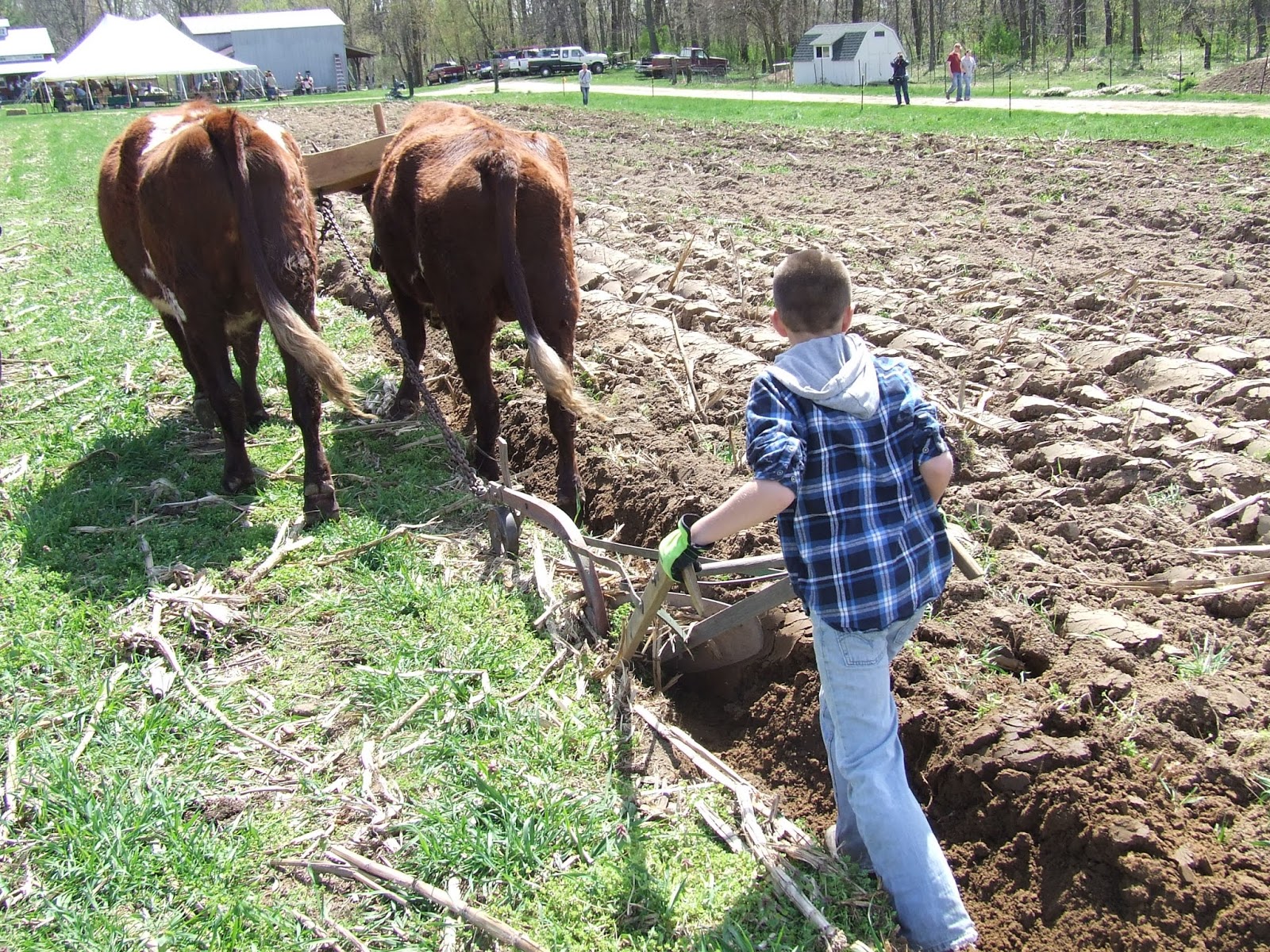
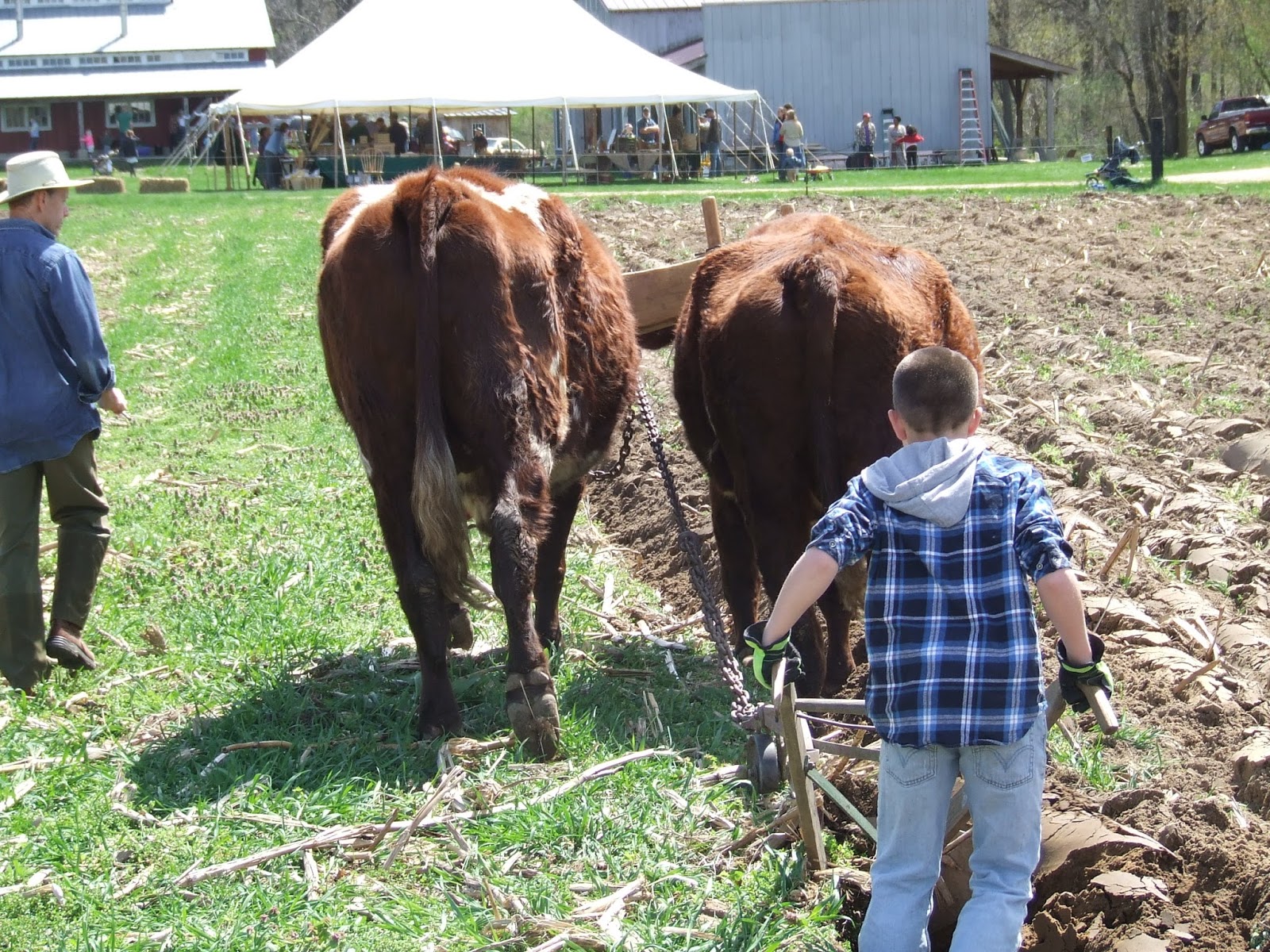
When teaching people to plow, we often throw out the standard advice: lean to the left to go right, lean to the right to go left, keep a light grip on the handles (so you could peel an orange with your fingers is how I describe it),  stand up straight, walk a tightrope in the furrow, etc.

With this cacophony of instructions, beginners often get overwhelmed.  Their brains can't keep up with the action, even with a slow team (see "Stuck in First Gear").

When they've been overloaded, most people follow their instincts- grabbing the handles and wrestling the plow down the field, trying to push it along.  The predictable result is frustration and sore muscles.

Lately though, I've tried a different approach.  Similarly to teaching handsawing, the goal is to let the tool cut, while the operator stays out of the way.

To demonstrate, I walk the plow, occasionally letting go of the handles.  If the oxen are pulling straight and the plow is set up right, it makes little, if any, difference.

Try it sometime.  Peeling the orange is optional.

Thursday, May 11, 2017

Hit the Dirt

My boys are big.  Probably a ton each.  Not unusually tall for shorthorns, but tall nonetheless.

So, there's really no need to accentuate their size with camera tricks, but getting down low makes for a much better shot.  Elise, who is interning at Tillers International this season, takes great photographs.  When I saw her working her camera during plow day, I spotted the secret.

"You can't be afraid to lie down in the dirt," she suggested.  Two shots from this afternoon as we gathered some mowed grass bear this out.

Though both photos were simply shot on a phone (an iPhone 5 for you technophiles), ignoring the rules for layout and lighting, the difference is stark anyway.

The top photo has depth and strength, while the bottom photo. . .  doesn't.  For it, I walked up a small rise (about 2 feet, really) and held the phone over my head.  7 feet of elevation separate the two shots, but it's a world of difference.
Elise getting down in the dirt for a shot.


Shoot your oxen.  From the dirt.  Send us the results (email: rcollins@cpschools.org).  We'd love to see how it turns out.


Tuesday, April 18, 2017

9 Miles

Saturday next, Tillers International hosts the annual plow day and open house.

A number of classes coincide with the event, but as the title implies, the centerpiece is plowing with horses and oxen.

The folks at Tillers favor using a walking plow and most often select the Oliver 99.

The reason they choose a walking plow is largely due to the practicality of the implement for international development.  Walking plows are still used in most places where draft animal power is employed (The plain communities of the United States would be a notable exception, with sulky and gang plows being more common).

The reason for choosing the "99" plow is that it's state of the art.  It's truly one of the most advanced walking plows on earth.  The joke is that tractor plows came along shortly after the Oliver 99 and so "state of the art" makes it nearly a century old.

Plowing an acre of land with a walking plow the size of an Oliver 99 averages out to be around 9 miles of walking for both the drover and the plowgirl (or boy, or man, or operator - no judgements here).  Done well, though, plowing is not the drudgery progress has made it out to be.  Farmer and author David Kline (who produces the very fine quarterly magazine Farming) explains it better than I:


“I enjoy plowing. Just this past year one Soil Conservation Service expert told me, in all seriousness, that if I'd join the no-till crowd I'd be freed from plowing, and then my son or I could work in a factory. He insinuated that the extra income (increased cash flow) would in some way improve the quality of our lives. “I failed to get his point. Should we, instead of working the land traditionally, which requires the help of most family members, send our sons to work in factories to support Dad's farming habit? Should we be willing to relinquish a nonviolent way of farming that was developed in Europe and fine-tuned in America? Should we give up the kind of farming that has been proven to preserve communities and land and is ecologically and spiritually sound for a way that is culturally and environmentally harmful? “Maybe I'm blind, but no matter which angle I look from, I fail to see any drudgery in this work. And I am convinced that if one farms carefully, soil erosion need not be a problem.”

Thursday, April 13, 2017

Yoke Maker's Bible

"This might be the best book on
 woodworking ever written." 
- Jim Crammond, Windsor chair 
maker and instructor.  

Hear me out.  The best book for yoke makers doesn't use the word "oxen" anywhere.  Not once.  Animal power isn't described.

The book ostensibly covers the process for building a Windsor Chair.  To my knowledge, writer and chairmaker Peter Galbert has never even seen a yoke, and his Chairmaker's Notebook doesn't overtly describe the first thing about them.

What Chairmaker's Notebook actually describes, in 400+ pages and 500 illustrations, is everything you'd need to know to make the best yoke you've ever seen.  (sans hardware) Think about it: a yoke is basically a large windsor chair with its carved beam acting as the seat and the bows functioning as well . . .the bow.

Wood selection? Yep, he's got it covered, starting in the woodlot.


Carving? Oh my, yes, with clear descriptions of grain direction, the subtleties of reading lumber, and the proper way to choose and sharpen tools familiar to yoke makers:  Adzes, drawknives, spokeshaves and (you should really try one on a yoke), travishers.

Bow bending?  Steaming, forms, drying times, tips and tricks are all there.

Finishing?  If you've ever tried -or shied away from- milk paint, you'll be equipped after reading Galbert's descriptions of the process- with lots of nice, color photos.

Finally, Peter Galbert loves traditional tools because they make so much sense even today in accomplishing a task that matters in a way that brings joy.  Sound familiar, ox drovers?

While Chairmaker's Notebook seems pricey at $54 (shipped), you get what you pay for.  Check it out.


Wednesday, April 12, 2017

Stuck in First Gear

Justice Collins plows with Marco and Polo in 2009 - on her 10th birthday.
Oxen, like so much else in this world, are a compromise.  At once generally cheaper and more rugged than horses, they move slower and tolerate the heat less well than equines.

When I first started driving oxen, Dulcy Perkins explained oxen as like having a tractor stuck in first gear, whereas horses were like having a tractor stuck in third gear.  Not better or worse, just different.

For teaching someone to plow though, first gear is nice to have.  Tillers team, Marco and Polo, plowed not so much in first gear as in granny-low gear.  They'd move forward, but just barely.  However, Polo would stay in the furrow, they'd walk a straight line and they would make most beginners look pretty competent.

For mowing hay, their creeper gear would wear thin after even a few minutes, and getting an acre plowed might take twice as long as you liked, but being stuck in first gear sometimes has its place.

"A man must plough with such oxen as he hath." - Chinese Proverb