Thursday, October 26, 2017

Beef Jerky

Last weekend I had Zeus and Cassius tied at the hitching post, waiting to be yoked up.  I generally take their bows out of the yoke and throw them onto their necks before bringing out the beam.  This means, though, that I have to place the pins and spacers on top of each hitching post while I go back in the barn.

The problem is that Zeus is a toddler.  An eight year-old toddler.  An eight year-old, 2000 pound toddler.  He loves to knock the pin and spacers off onto the ground.

Emerging from the barn carrying the beam, I noticed Zeus chewing intently and smacking his tongue.  I immediately scanned the ground and noticed the wooden spacer and, more importantly, the pin on the ground.  Thinking I had that base covered, I set about feeling around in his mouth for a foreign object- no easy task with the chewing going on.  

Two or three failed attempts later, I started to assume that he was in fact chewing his cud and things were fine.  Then I noticed he was clearly working on an object.  

Back into his mouth went my hand, only to return with a well-chewed leather spacer, looking for all the world like black beef jerky.

Either that or Zeus was acting as if he was a 'jerky" beef animal.  You choose.  Either way, keep your eyes on the toddlers and make sure they have a magnet in them.  You never know what they'll pick up.

Monday, October 9, 2017

Edward Scissorhands

In the 1990 film of the same name, Johnny Depp's title character is able to deftly use both hands to accomplish tasks with efficiency.
A pair of brushes atop the hitching post.

In working cattle, a critical-but-routine task is to brush the animals at the hitching post.  The animals are calmed by the act of brushing, they appreciate the routine, and they are much easier to catch and halter when they know the hitching post will have a pleasant activity to start.

Side note:  Animals that run off due to fear often run to the hitching post.  In the classical conditioning language of psychologists, the neutral stimulus of a hitching post has come to be associated with the pleasant unconditioned stimulus of brushing.  When animals are trailered to a location and yoked at the trailer, it takes on that same "magical" quality for the animals as a safe haven.

Anyway, to speed up the brushing, I often use a pair of brushes, one in each hand.  That way, I can cover twice as much coat at once.  With a full-grown ox, they seem to have about an acre of coat that needs brushing.  The animals like the extra attention and it speeds us along. 


Sunday, October 8, 2017

Not Exactly NASCAR

Without much time to work oxen these days, necessity has helped birth efficiency.  One of the time savers I tried the other day may just make its way into the "normal" work routine:  the pit-stop nigh ox swap.

Having three oxen means I try to get all three in a yoke whenever they are out so they all stay as sharp as I can keep them (see: the aforementioned lack of time).  Cassius is the best off-ox, so he usually works a shift with both Brutus and Zeus.

Making the switch used to involve unyoking Cassius in most cases.  But the last few times we've switched, I've just dropped the nigh side of the yoke on the ground while I swap Brutus and Zeus from the "other" hitching post (just a fence post where one animal is tied while waiting to work).  Then I just walk Brutus up and have him step under the yoke while I lift it.

Two or three times of this and he seems to have the routine down.  And I just saved a couple minutes, plus the effort of lifting the yoke twice.

It's not a NASCAR pit stop, but it'll do.

Sunday, October 1, 2017

How's your Team?

When I see folks in the fall, they often ask, "How's your team?"

It's important to remember how I know them so I can answer correctly based on the question they're asking.  If they're oxen people I have to, sheepishly, tell them that they're not getting much work these days.  If they're folks from the Centreville community, we talk cross country and I tell them about that team.

This fall is my 20th season coaching runners in the same school (Centreville High School in St. Joseph County, MI) and as happens every fall, the days aren't long enough to manage getting teaching, coaching, a little housework, homework, family time, church choir, AND oxen driving.

But that's the nice thing about oxen.  They remember.  They stay relatively calm without daily work.

All three of the boys get handled every day with feedings and in moving from pasture to dry lot, etc., so they stay pretty sharp, if not really ready for hard work.

Yesterday, on my first day without something scheduled in September (the 30th!), I managed to have the oxen out for about 3 hours.  We spent most of our time moving equipment around the yard to make lawn mowing easier.

Zeus and Cassius went first and they were well-behaved-if-not-exactly-willing.  Then I swapped out Zeus for Brutus in the nigh position and we worked for about 45 minutes without me having to say anything to them, with one exception, but that's a tale for another time.

How's your team?


Thursday, August 31, 2017

Wheeling a barrel?`

That contraption with two handles and a single wheel in the front?  It's called a wheelbarrow.  The "barrow" part comes from and Old English word that describes a device used to carry a load.  The "wheel" part. . . well, I guess that part's pretty obvious.  It's not a wheelbarrel or a wheelborrow.  Barrels would roll on their own, and if you lend out your wheelbarrow (thus, making it a wheelborrow), you might as well call it a wheelgift, since the only reason anyone borrows one is to mix concrete, and you won't want it back afterwards.

So now that we've had our etymology lesson, I didn't come here to talk about wheelbarrows. I came to talk about the oxen substitute for them:  slip scrapers.
Hauling compost.  And a shovel.
The angle of this photo makes the left handle look longer than it is,
but it doesn't stick out more than 18 inches from the back, I swear.

Traditionally used to move material by digging into it and dumping it at the destination (More on that at some other time, but you must pinky-swear here and now that if you get a slip scraper and you're going to put handles on it, you'll put short-enough-to-look-ridiculous handles on it.  Long handles will quickly turn a slip scraper into a slip catapult), slip scrapers are also useful for almost all of those wheelbarrow related tasks:  moving one bale of hay, hauling dirt or compost, and carrying loads like rocks or bricks.

Slip scrapers don't hold any more than a wheelbarrow and the advantage of loading down low is negligible, but you get the task done and you got one more chance to work your oxen, which is more fun that wheeling a barrel, whatever that is.


Saturday, August 12, 2017

A Stone Canoe

Trying to get the threads at a
consistent height.  Nobody will
care, but I like the look.
Ok, that sounds like a totally useless item, but hang in there. . .

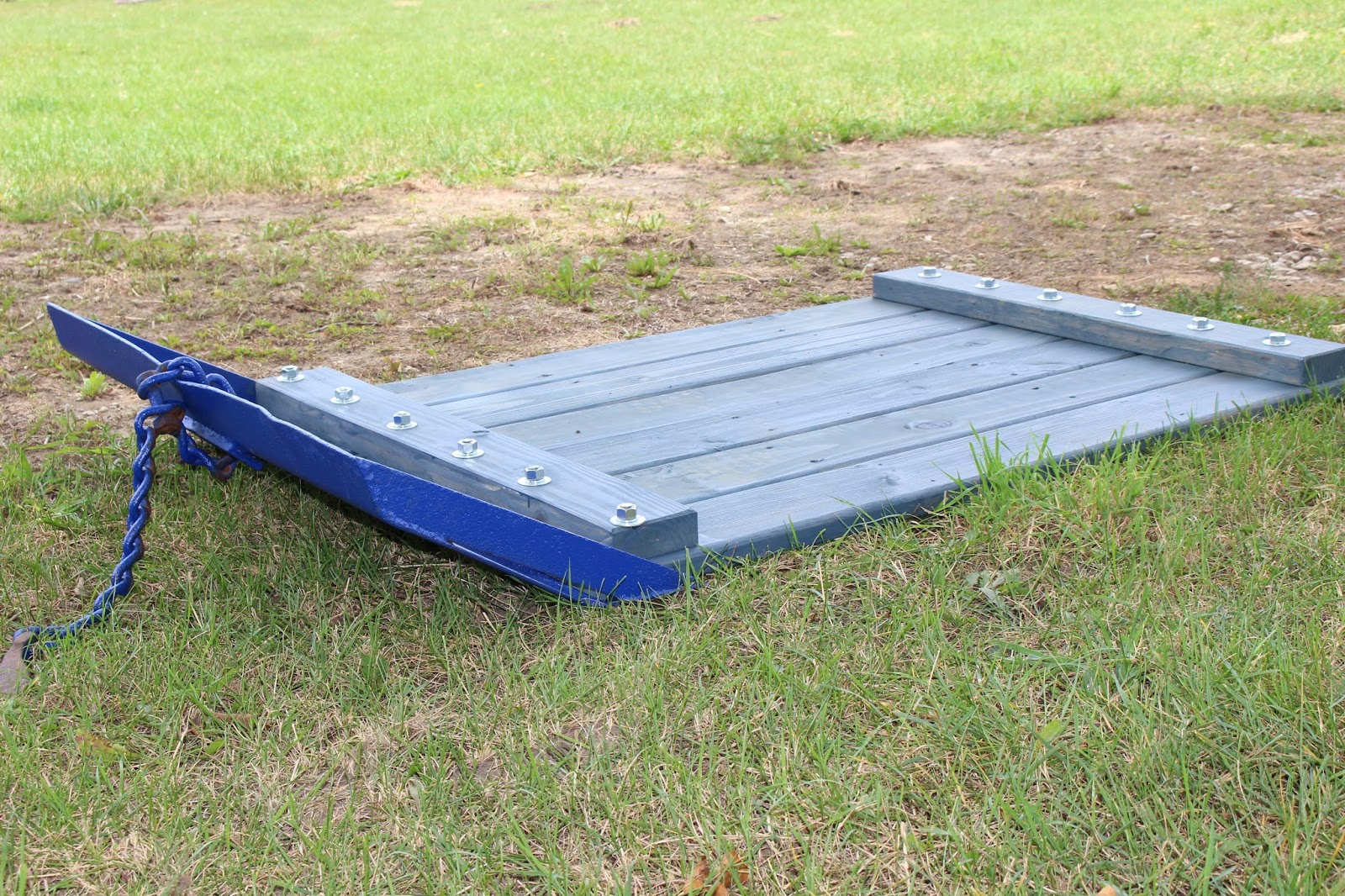
I've got a stone boat.  A nice, big one.  A really nice, big, heavy one.

The head is cast iron, with a fresh coat of paint.  Southern yellow pine planks, outfitted with painted, chamfered and planed battens.  It's heavy.  And a little too nice to leave outside in the elements.  (I store it inside, but how I get it there may be the topic for another post down the road).
Sometimes, I find myself wishing for my old, beat-up stoneboat.  The head was a plate steel that was obviously farm-made many years ago.  I found it in the weeds at my farm when I moved there years ago.  Sturdy, but not too heavy.  I bolted a few scrap boards to it when Zeus and his partner Hermes were just calves.

2 minutes with a block
plane adds a gentle chamfer.
 It was hideous, but other than a terrible mishap when we first hooked to it years ago (again, probably another post someday), it worked well until the boards fell apart this spring.  If only I had some scrap wood. . .

In early summer, a friend of mine was discarding some very lightly used 16-foot 5/4 deck boards (my favorite price) so I cut them into 4 foot lengths, ripped one a little narrower to fit the width of the head - 32 inches - and bolted them together using new 1/2 inch carriage bolts and a little Phil Wood waterproof grease.
I try to grease every nut.  Cheap insurance.

Since I had the boards all ready, I gave them a coat of oil-based stain in my favorite shade of blue.  I think it was called "I-have-this-on-hand-from-another-project-maybe-the-ox-cart" blue.  It generally coordinates with the "Ink Blue" Rust-Oleum spray paint that was on sale for $3 at Meijer this week.

Finished up: Around $20, weatherproof, sturdy, lightweight, but smaller than a stoneboat.  It's a stone canoe.  Because stone dingy just sounds silly.

Too bad it turned out so nice.  Kind of a shame to leave it outside. Maybe I should be on the lookout for another stone boat head. . .
A little small for big Brutus, but he doesn't mind.


Sunday, August 6, 2017

In or Out?


We once had a student who struggled so much with "gee" and "haw" as a beginning teamster, that I jokingly suggested he write them on his hand.  

He did.

Not surprisingly, his driving didn't suddenly take a great leap forward.  The act of stopping, looking at his hand then translating the word into some movement made the task, if anything, more difficult.  

But I do feel his pain.  I have the occupational
hazard of often not knowing my right from my left.  As an American Government teacher for many years, I explain the political spectrum, maps, and several other things while facing my high schoolers, as if they were on an clear wall between us.  So I think in reverse with left and right at times.  But only when I stop and think about it.  Mid-lecture, I just know where socialism is in relation to mainstream conservatism.  

Watch a kid play a video game and you'll get the idea of how to drive.  Try out a couple of controls, then stop thinking about it.

But what if you're driving Zeus, who works 90% of the time as a single or a nigh ox, but he's working on the off side?  When the team needs to "step over haw," (a command, by the way, altogether different from "step haw."  "Step haw" means to come forward turning sharply left.  "Step over haw" means to sidestep to the left.)  Zeus needs to "put in" toward the chain, but you can't tell him that.  I know.  I tried.  If you tell him to "put in" in that position, he steps out, just like he's been taught.  

"In" and "out" to Zeus mean "left" and "right."  

How about your team?  Do they know that "in" and "out" are positional commands, rather that directional ones?  

Or does it matter?  If you're getting the work done with the kid-and-a-video-game-method, it's all good.  But if something changes, take a second and try to figure out where the confusion is.

Socialism is on the left, by the way.  Your left, my right.