Friday, January 22, 2021

Hay Staging


 All the world’s a stage,
And all the men and women merely players;
They have their exits and their entrances;
And one man in his time plays many parts,

              -William Shakespeare As You Like it


When words act as multiple parts of speech, I get excited. This week we staged some round bales. "Staged," as in placed them in position to be fed later. But to keep them off the ground and make unwrapping the net easier, we placed them on a "stage," in this case, a pallet.

A lucky guess on where the flat spot would land.
It's a fun task to "stage" round bales- with all that hooking and unhooking.  The basic set of steps is this:


1. Pull the stone boat up next to the bale (in this case, the bales had a flat spot, so we judged where the boat needed to be to have the bale land correctly.

2. Hook a hay hook into the netting and run a chain over the bale.

3. Move the team so they are oriented perpendicularly to the stone boat.

4. Link an additional chain onto the "hook chain" and hitch it to the yoke.

5. Take just enough steps to roll the bale on to the boat. (Normally, I like to leave the bale with the axis pointing skyward right on the stone boat and feed it like that, but it does tie up the stone boat for the next few days and it means you can only move one bale at a time.)

5. Pull the bale to the staging area. (In our case, next to the pasture fence. We peel and feed hay 2x a day.)

6. Throw a pallet down behind the stoneboat.


7. Repeat steps 1-5 to roll the bale up onto the pallet. (In this case, the axis is skyward, making unwrapping easier)

8. Hook to the stone boat and go back for another.

Like I said, lots of hooking and unhooking.  Half the time the team hooks they have a heavy pull, as they are pulling the bale and the boat. The other half, they are flopping a bale, which I could realistically do myself.  That's nice. It makes the team pull "gently," no matter what.

. . . And if the senior Senator from Vermont offers to help, let him.


Sunday, January 17, 2021

Penguin Walking


Looks fine.  So does a mine field.

When I was in my middle-20's, like everyone else, I knew I was invincible. But an icy trip to the mailbox did its best to disabuse me of that notion. I can still see it in slow motion: One minute I was up. The next, I was down in a heap. All that was missing was the Wile E. Coyote swirls in the air as my feet, no doubt, reached shoulder height.

This time of year, I'm likely to heed to warnings to "walk like a penguin" on the ice. (See diagram)

As a result, I'm always reluctant to get the boys out when it's icy. The catastrophic costs simply outweigh the benefits.  (Warning: the story at this link is gut-wrenching .) Yesterday, though, we were in that grey area between penguin walking weather and skip-to-the-mailbox weather. The ice had mostly cleared, but the lack of snow had frozen the ground just below the surface. Most places were fine, but the few slight slopes were sketchy at best.

As a result, everyone got a lead rope to the hitching post and back. Taking a chance at Zeus's natural exuberance seemed foolhardy. Walking up and down the slopes and on the icier areas, I walked directly in front of the team to keep the pace indolent. We skipped hauling out a round bale, knowing that they'd need to dig in and pull and we'd be walking at a good clip to do that.  

Live to fight another day.  Last evening's snow appears to have insulated the ground enough to thaw the frozen layer, but I'll walk out like a penguin before getting the boys.

Tuesday, January 12, 2021

Be Annoying

"I'm not touching you!" *Holds fingers inches from your face*
                                                - Every sibling in history


I enjoy bugging the pets. The dogs have to endure photos with costumes and hats. Same with the oxen. I probably have more oxen-hat-photos than you have oxen photos. Really. 

I also make a regular practice of running hands on the cattle.  A hand around a horn sometimes.  A push of a head. Little things to remind them that I intend to hold my status as the biggest, strongest ox of them all.  As long as they believe it, I'm good. Much of that could reasonably be argued as training.  

But I also have a general propensity to annoy the boys. They have to listen to show tunes when I feel like singing. (In my defense, if there is a bright golden haze on the meadow, it bears mentioning.) 

I also often rub their eyes.  If they've got debris in the corners of their eyes, I brush it out. When we stop for a break, I massage both eyes, my hands rubbing each closed eye while they have to stand and put up with it. Sometimes, I think it calms them down. Others, it calms me and they just have to put up with it. I never thought of it as training. But Cassius has pink-eye.

The vet gave him a prescription.  "A 1/4 inch bead in each eye, every 8 hours, for 8 days." With an 8 year-old, 2000+lb. ox, that sounded a whole lot like: "Aim for some ointment to hit the eye while dodging horns and hooves as the animal dances around looking for an escape route with the one good eye not yet affected by the pink-eye."  

But off I trudged, halter in hand to find the boy in the pasture. "Cassius, head up." Up came his head to take the halter. "C'mon," and we walked to a fence post where I tied him pretty short and tight. 

Then came the moment of truth: He squinted a bit, and would have preferred that I didn't try too hard to hold his eye open. But he stood like a gentleman for both eyes.  

A few days into this, our routine has changed only a little. I've taken to putting his halter on, dropping the lead rope on the ground, and stepping on it.  That little bit of tug keeps him in place. I'm 90% sure that he'd stand for me doing it without any halter, but why risk it? If he never learns he can get away, he never learns he can get away.

So be annoying. And the eye is looking better.

Monday, January 4, 2021

A Hay Toboggan

If we both look away, the load must disappear.
 The calves usually get worked after a bowl of sweet feed. With this pair, it has worked out well to feed them, do other chores, then come back and get them out. Yesterday, "chores" was to make a few repairs on an old, wooden toboggan of my in-laws.  

Having done that, it seemed silly not to drag it around on the new snow.  A quick length of baler twine, a small loop made with a, "half-hitch" to hitch to, and we were ready to go.  (Pun intended, but truth be told, it may have been a half-hitch or it may have been a triple granny knot. I am the world's worst knot-tier.)


The toboggan makes a pretty nice work sled for something like this.  It pulls easily, turns sharply without drama, and doesn't run up on them in the wet snow we had by mid-afternoon. We did one lap around the yard, then walked back to the barn for a bale of straw for the big boys.  Another lap, and it was back for a bale of hay.  

We had one small 'running event' for about 50 feet (I could see they would stop
to sniff the hayrake, so I kept up with them and said "whoa" as they got to the rake.), but all-in-all they did well working without using a rope as an emergency brake. Once we got settled down, they stood under voice command while I got the bales out of the barn- out of their sight.

The Hay Toboggan: a nice complement to The Stone Canoe.


Friday, January 1, 2021

The Best Runaway Doesn't Happen

 "We used to figure that every team new to a cart would probably have one runaway" - Dick Roosenberg


Helping with Oxen Basics at Tillers International for years and then teaching the class a few times, I've been lucky to watch dozens of oxen start their careers.  One of the big milestones is when they pull a cart for the first time.  It can be quite a rodeo, but it doesn't have to be.

Reasons FOR a runaway:  

-A cart is "new" to the team.

-Carts make funny noises, dissimilar to chains and dragged objects.

-Carts have a tongue that weighs down the yoke, a new sensation.

-Carts are a visual that is larger and higher than a dragged object, making them appear to be a larger predator.

-Carts get louder as they move faster.

-Carts "push" the animal on the inside of any turn with the tongue.

-Carts "push" the yoke when the team tries to stop them.

-Adding any two of these factors is not simple addition. It's more like exponential growth for a feedback loop.

Dealing with any and all of these things is pretty similar to the approach I described for an adult team here, but with some minor changes, so let's use the original list to talk through ways to avoid a runaway.

Ways to AVOID a runaway:

-A cart is "new" to the team. Everything is new to calves.  They are visitors to the "Everything Else
in the Whole Wide World Museum." Let the team see and smell the cart. Make time with new things to let them see you acting calmly while they explore.

-Carts make funny noises, dissimilar to chains and dragged objects. Everything following calves can be seen as a predator.  Start by having a partner pull the cart away from the team. If you're by yourself, tie them and pull it "parallel" to the team. Cars travelling along the road don't spook animals as long as they are moving in a predictable way.  Same with 'real' predators on the prairie. Make the cart replicate that so the noise is created in a 'safe' way. We trained a pair of Jerseys that followed the cart and would catch it and sniff and lick it while walking along. Not surprisingly, they didn't spook when hooked to the cart.

-Carts have a tongue that weighs down the yoke, a new sensation. Assume that all animals believe that any new thing is permanent.  They fight a halter since they believe that it's new and will always be there. Same with anything.  Reset that expectation with anything new.  Put it on, take it off. Repeat. By the third time the tongue is in the ring on the yoke, it's usually old hat.


-Carts are a visual that is larger and higher than a dragged object, making them appear to be a larger predator. Ok, there's no solution to this, only an opportunity. Forever, the team will need to stand while the objects behind them change size, shape, and sound. Watch a sound team like Kevin Cunningham's stand for a tractor to load manure into the "ox box," and you'll quickly see why it's an opportunity to build soundness and not an obstacle to success. 

-Carts get louder as they move faster.  Step once. Stop. Step. Stop. Step. Stop. Step. Stop. Step. Stop. Step. Stop. Step. Stop. Are you bored yet? Yeah, they are, too. Problem solved.  

-Carts "push" the animal on the inside of any turn with the tongue. Again, an opportunity, not a problem. Working animals need to sidestep.  Practice, rather than genetics, makes that happen.

-Carts "push" the yoke when the team tries to stop them. We probably should have started with this, but start out going up a gentle rise.  When they stop, the cart stops, rather than pushing up against the team with momentum. If you need to unhook and walk the cart back down a few times, imagine yourself as a 'good' trainer rather than a 'slow' trainer. 

-Adding any two of these factors is not simple addition. It's more like exponential growth for a feedback loop. Yes, a lead rope is probably a good idea at first. Yes, the odds are now ever in your favor.  

Yes, you can do all of these things well and have a runaway. A panicked runaway with calves on a cart is something you won't forget. But the team will. Once. Maybe twice. Learning that they can simply run with a cart and get away from you?  That's another matter. And, as we say, a tale for another day.


Wednesday, December 30, 2020

Eagles Scavenge: Affordable Calf Carts


Particularly this time of year, it's a bad week if I don't see three or four bald eagles.  Once you know what to look for, (a "golf ball" in a tree) they seem to be ubiquitous.  In the right spots.  Water helps. A tall tree away from other trees or along the edge of a woods helps. But find a roadkill in a spot like that and your odds go way up. We think of eagles as majestic killing machines -and they are- but more often, they let a Toyota Corolla do the hunting and simply scavenge. It's a more reliable source of food. 

So it goes with calf carts. When you need one, you need one. By the time you build one, you no longer need one. The solution is simple: build a cart well in advance of the need. While you're at it, tell the eagle: "You're a hunter. Spend your time hunting. you might succeed. Eschew that fresh meat on the roadside."

Yeah, right.

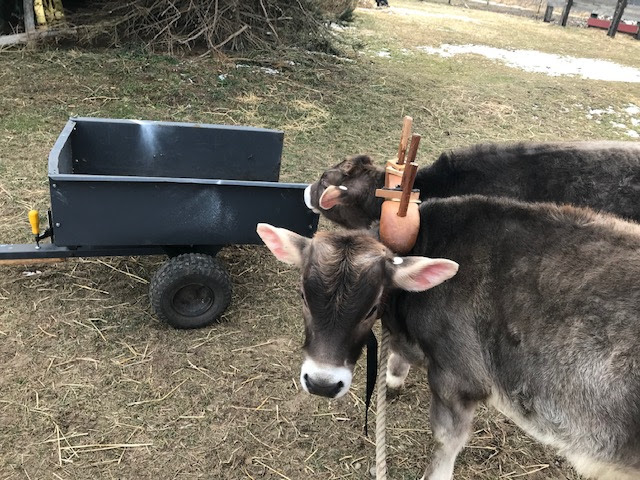
A good calf cart is one you've got access to. With some scavenged parts. Those small, metal garden carts are quite common in the aftermarket for just a small price. Or borrow one, like I did (I think I hauled one away, lent it to my dad, then borrowed it back).  Then make a tongue. 

Or scavenge one. In this case, the tongue had been up in the rafters of the corn crib for years before I bought my farm, then years since. Lying face down, the bottom had rotted badly, but 2 inches of good material remained on top.  A couple of minutes with the bandsaw and a jack plane narrowed it to fit in the existing U-shaped tongue of the cart.  A 1/2" bolt through the hitch and the wood makes a sturdy rear hitch point and one more 1/2" bolt will keep things secure.

Will keep things secure. For the maiden voyages, a wood-clamp holds things tight while we prototype the fit. So far, so good.


Next time: How to keep the cart in the same county when introducing it to a team.


Monday, December 28, 2020

St. Peter's and the Crowbar: A Trailer Tale

 Part 1: The "Old Trailer

Justice Collins in front of St.
Peter's.  About a half mile away


St. Peters Cathedral in Rome boggles the senses. It appears to be on a scale comparable to "regular buildings," until you get close. It's proportional in such a way that, inside and out, you don't get a feel for its immensity.

Oxen aren't like that. For an appreciation of that fact, get one inside something. Barn, stocks, or trailer.  See what happens? They grow.  

So it is with Brutus. He's big for an ox, but not huge for an ox. Same with Cassius. For a couple of years, they have been pushing the limits of my first trailer. It's a 1999 model draft horse-size horse trailer.  A little too short for the bodies of the big boys (although Zeus fits quite well), a little too narrow. But we got by.  Brutus and Cassius were too wide to ride together, but Zeus and Cassius would. So we got by. Zeus and Cassius were too wide to let me safely pass between them, so I used the escape door. We got by.  The floorboards were still solid, but with 3/4 inch plywood on them the load would be distributed. And we got by. Until we didn't.

Brutus outside: Sorta big

In August I taught Oxen Basics at Tillers, taking the three boys along. Two trips, one afternoon. Zeus and Cassius went first. No issues (ignoring the necessity to use the escape door to get in and out).  

Brutus was reluctant to load up for trip number two.  That's not unusual, but a few minutes of coaxing and up he went.  I tied him short in the manger and was shutting the back door when he stepped back out onto the ground with his back feet.  Remember, the trailer is just a wee too short. Stepping back up, head still tied, he slipped and went down. Not a second later, he was up and in place with a lurch.  I shut the door and got him some hay for the manger.  

Opening the front manger door, I slid in the hay. He took a nibble, but only just. Then I noticed that his head wasn't moving. At all. 

Brutus inside: very big.

When he lurched back into the manger, his horns had gotten ahead of the frame and one side was stuck against the steel divider, the other horn was wedged against the roof.  

I pushed and prodded from through the front opening to no avail.  

I got in next to him and asked him to sidestep. He did. Both ways. No effect.  At that point, I was in a real state, as was he. I could just see him shelling the horn and what that would look like. 

Call someone to help? Not a chance. Once he saw a stranger, he'd be more likely to panic and make things worse.  

Back in the trailer. More sidestepping. Same results. The only difference was that I could see that being in there with him would be dangerous if he did get free. St. Peter's the trailer is not, in terms of size.

Finally, after about a half an hour of this, I got a crowbar and pried from the outside of the trailer against the roof and the horn. Out he came.  

I released him and we walked around the yard for about another half hour.  Then we loaded and made the trip. After four days of class, he loaded, but not well.  It was time for a new trailer.  

A foot wide, a few feet longer.  All aluminum.  

None of the big boys have been inside the new trailer yet. That will have to be a tale for another day.